
AACR Annual Meeting 2026 · Conference briefings
AACR 2026 — Where AI Showed Up in Cancer Research
We read 7,066 abstracts at AACR 2026 to answer one question: where is AI actually showing up in cancer research today, and where is it still missing?

/ 01 /
First, the size of the room
Before reading any abstract, we counted them. AACR 2026 published 7,066 abstracts and indexed them under 4,001 keywords. The most common keyword was tumor microenvironment, tagged on 545 abstracts. Then breast cancer (453), antibody-drug conjugate (387), immunotherapy (341), biomarkers (340). These are the things cancer researchers are working on.
The number we want to point at is further down the list. "Machine learning" shows up on 189 abstracts — ranked ninth overall. That puts it ahead of metastasis (186), drug resistance (146), and combination therapy (137). Add bioinformatics (163), single cell (165), and multiomics (150), and you're at roughly a quarter of all abstracts at this meeting.
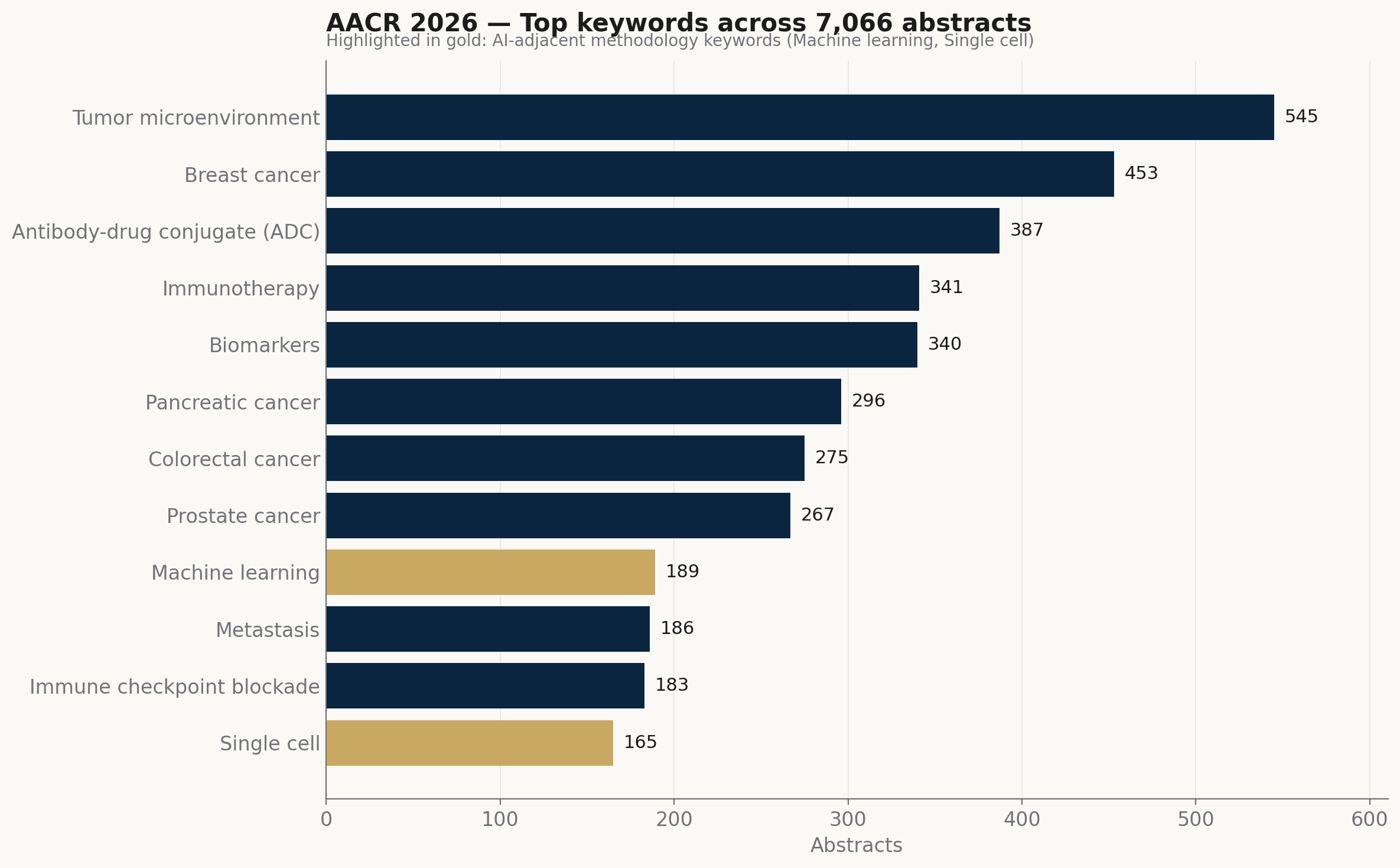
Top 12 keywords across 7,066 AACR 2026 abstracts. Machine learning sits at rank 9, ahead of metastasis and drug resistance.
Source: AACR 2026 program · AAI analysis
On its own, that's not new. AI has been a presence at AACR for years. What's different this year is that it doesn't need to advertise itself anymore. Machine learning isn't the news of the paper; it's the substrate the paper sits on. That's the move from being a method some people use to being a method everyone uses.
/ 02 /
Three places where AI is the default tool now
AACR sorts every abstract under one or more topic codes. Three of those codes — all in the BCS (Biostatistics, Bioinformatics, and Computational Sciences) family — give us a clean read on where computational work has become the center of the research, not a tool added at the end.
BCS01-02 — Application of bioinformatics to cancer biology — covered 143 abstracts. That's more than any other technical-methods topic on the program. The single biggest abstract block was a 30-presentation poster session on April 19, the first full day of the meeting. The framing has shifted: bioinformatics is no longer supporting wet-lab biology from the side. It's where the question itself lives.
BCS01-04 — Digital pathology — covered 61 abstracts. The interesting part isn't that pathology uses neural networks; that's old news. It's that the questions have moved on. People aren't asking "can a model read this slide?" anymore. They're asking how to deploy it across hospital systems, how to validate it on patients who don't look like the training set, and how to keep it working when the data drifts.
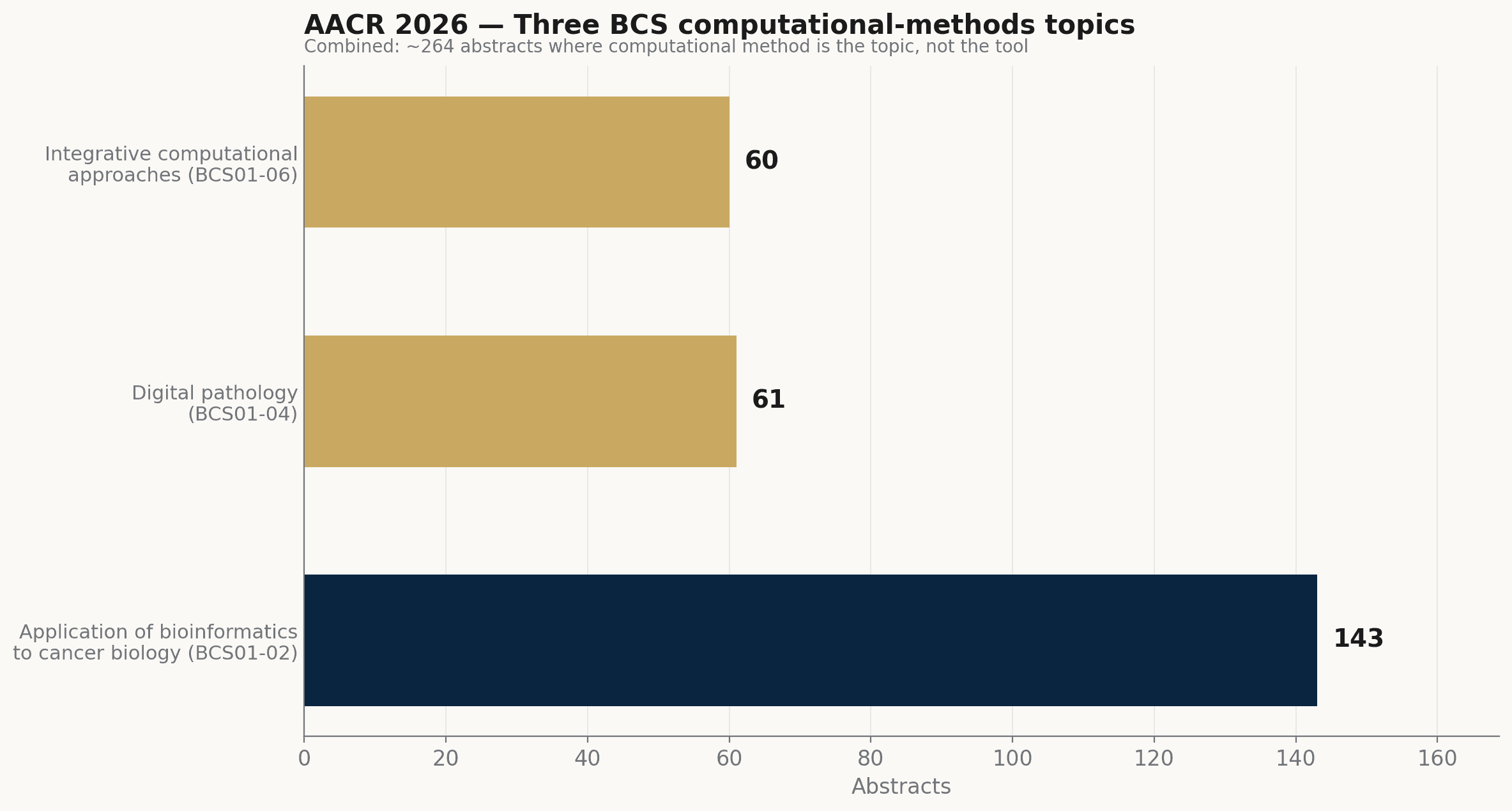
Abstracts in the three BCS computational-methods topics. Bioinformatics is the biggest of the three. Digital pathology and integrative computational sit close behind, and the work in those areas often overlaps with foundation-model research.
Source: AACR 2026 program (AdditionalFields) · AAI analysis
BCS01-06 — Integrative computational approaches — added another 60 abstracts and a 29-presentation block on April 20. Most of these papers fuse different kinds of data: genomics with imaging, single cell with bulk tissue, spatial with longitudinal. The math here isn't doing statistics. It's doing translation — moving information between formats so a model can see the whole patient at once.
/ 03 /
Foundation models earned their own room
Last year, foundation models in cancer research showed up as side notes — a few plenary slides, a handful of abstracts buried in computational sessions. This year, they got their own symposium.
It's a Major Symposium called "Shaping the Future of AI: The Role of Pathology in the Development of Foundational Models." The framing alone is interesting: pathology slides are being positioned as the training data of choice for large vision models in cancer biology. AbstractsOnline matched the symposium to a 16-presentation Molecular Pathology block.
Symposium-level placement is worth reading carefully. It means the program committee decided foundation models aren't one method among many anymore. They're a category that needs its own room. That's the year-over-year change worth marking. Next year's signal to watch: whether the same treatment extends to multi-modal models — the ones that fuse imaging, omics, and clinical text.
/ 04 /
Three kinds of AI we expected to see, and didn't
Counting absences is harder than counting presences, and easier to get wrong. We searched the program for keywords that would have been technically natural to include and read the surrounding session titles for context. With that caution, three kinds of AI work were almost entirely missing from this meeting.
AI agents for research workflows. In the last year, language-model agents have become real tools in laboratories and literature reviews. The program returned almost no abstracts that frame AI as an autonomous research workflow. "Copilot" and "agent" did show up — but in the clinical sense, meaning therapy-context, not methodology. The work is happening; it just hasn't reached the conference floor yet.
AI in clinical trial design. First-in-human dose finding, biomarker-driven basket selection, adaptive randomization. There were strong sessions on biomarkers and on trials in general — but the design layer itself was still mostly classical statistics. Given how much first-in-human oncology activity is happening this year, this absence surprised us most.
AI in regulatory science and post-approval surveillance. A few policy-adjacent forums touched on the topic, but the methodology — auditing models, monitoring drift after a drug ships, validating real-world evidence for label expansion — was thin. This is a gap the wider field shares. AACR has the room to lead it.
/ 05 /
What we take away
Read as a single map, AACR 2026 says this. AI in cancer research has settled in as a way to do work, but not yet as a way to organize work. The methods are everywhere. The workflows that use those methods to run research, design trials, and govern deployment are mostly somewhere else. That gap, we think, is the durable observation from this year's meeting.
It is also where Apex AI Institute's drug-development line sits. Pillar 1 builds agent-based first-in-human scouting systems and computational landscapes for early oncology trials — work that fits exactly inside the gap the program left visible. We'll write about those systems in the briefings to come. The template that carries this article will carry them too.